
Positional Analysis: Back Mount
Owner & Head Instructor, Ground Rules Academy
In interviews with modern jiu jitsu legends (namely Roger Gracie and John Danaher), I noticed differences in opinion about which position is the most positionally dominant and superior for launching submission attacks. Roger prefers the mount, and John and his team prefer back control.
In my own experiments, I found that the gi (or lack thereof) plays a role in this preference. The addition of friction and grips makes all positions easier to control and adds many new submission opportunities, but this advantage feels amplified in mount when compared to back control. For one, the threat of the cross choke from mount opens so many possibilities that simply do not exist without the gi.
The no-gi world has found that distributing attacks between the legs and back can be a very powerful strategy in competition. Danaher and his team developed and refined the straitjacket system to systematically negate limbs used for submission defense, resulting in very dominant wins. This level of control comes from the nature of the position and would be arguably more difficult to achieve if the defender could form sleeve grips.
There are other asymmetries between these competition modalities in these positions, but let’s remove the clothing factor and focus on the anatomy of the positions. We will be looking at a few factors for each position and (subjectively) rating them based on their relative level of difficulty [on a scale of 1 (very easy) to 5 (very hard)]. The factors are:
Gaining Position
Maintaining position
Negating submission defense
Mount
Gaining Position: Difficulty 4 : One must get their opponent’s back to the mat and then access to torso by overcoming their defensive frames.
Maintaining Position: Difficulty 2 : With the opponent’s back to the mat, their best (and practically only) method of generating movement is hip extension. These muscles are large (glutes and hamstrings), but if you can negate them then you can control the position for a long time. Plus you have gravity on your side – a massive advantage.
Negating Submission Defense: Difficulty 4: The defender’s hands are in front of them and can meet the attacks head on.
Back control
Gaining Position: Difficulty 3 : Back exposure is more readily available than mount opportunities. A good guard player can protect his/her back with the mat and the mid-section with frames, but the back is not always on the mat.
Maintaining Position: Difficulty 4 : The defender can counter your positional control with the tools in front of them, and the defender can often use gravity to his/her advantage.
Negating Submission Defense: Difficulty 2 : It’s difficult for the defender in theory to defend submission threats when they are coming from behind.
With this brief analysis, we can see why many people find back control to be the superior position. There are fewer difficulties to overcome. But perhaps Roger is on to something in that if maintaining the mount is relatively easy, then you can unlimited attacks from a stable position even if negating submission defense is difficult. Position before submission after all…
There is a hybrid option that incorporates the strengths of both. The only cost is difficulty to gain position.
Back Mount
Gaining Position: Difficulty 5 : Requires back exposure and then breaking their defensive frames from behind.
Maintaining Position: Difficulty 1 : This position is very hard to escape from. The defender is unable to generate significant force from the tools in their frontal plane and they are carrying the combined weight of both grapplers.
Negating Submission Defense: Difficulty 1 : In addition to the difficulty of defending threats coming from behind, the mat has significantly restricted movement. If you can trap your opponent’s arms under their body, then defending the submission is practically impossible.
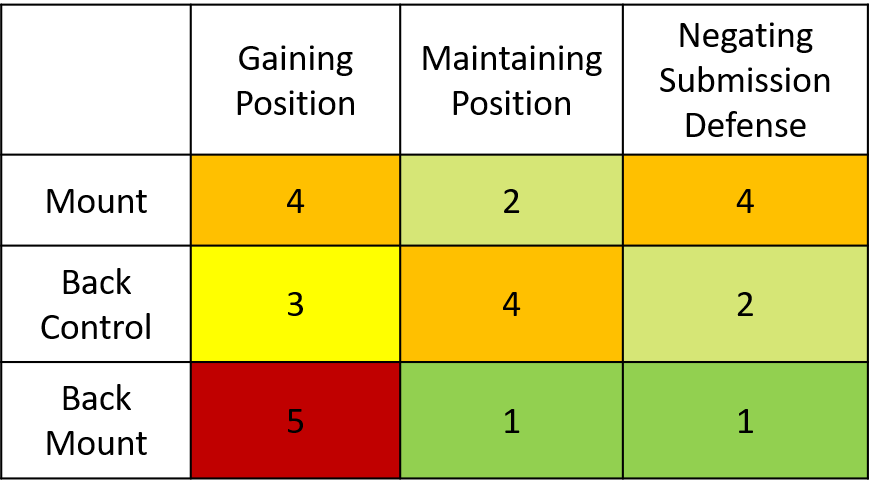
Back mount (preferably with hooks to pressure the spine) combines the positional control of mount and the submission defense negation of back control. And then some. The challenge is that it’s very difficult to achieve this position reliably, which is an active are of study at Ground Rules Academy. Come in to the advanced class and work it out with us!
Russ Jensen, PhD is a Brazilian Jiu-Jitsu black belt and the founder of Ground Rules Academy in Pleasanton. With a PhD in physical chemistry from MIT, he brings a unique, science-based approach to teaching technique on the mats. He is the author of Ground Rules: Simple Physics for the Grappling Arts.