
October Newsletter
Fall is here and October is packed! We're kicking off the month with Movie Night on Saturday 10/3, a few of our kids and adults are gearing up for the BJJ Tour U.S. Open in November, and Ground Rules is an official host of the We Defy Foundation's Veterans Day Ruck/Roll. We also put together a full review of everything we covered in September, so you can keep sharpening those details between classes.
Movie Night 🍿
Movie Night is back! The kids are invited for pizza, drinks, and a movie on Saturday 10/3 from 5 to 8 PM, which means parents get the evening to themselves. It’s free, there’s no age limit, and no RSVP is needed, so bring your friends and family! Drop them off and go on a date! ❤
Upcoming Tournament: BJJ Tour U.S. Open
A few of our kids and adults will be competing at the BJJ Tour U.S. Open on Saturday and Sunday, November 14-15, at Independence High School in San Jose. If you're interested in registering, let us know so we can help you get ready!
Register for the BJJ Tour U.S. Open. Registration closes Monday, November 9 at 11:59 PM.
It's also a perfect warm-up for those of us with our sights set on the IBJJF San Jose Winter International Open in January. If you're interested in competing there too, please contact us at info@groundrulesacademy.com so we can get you formally registered with the IBJJF.
Veterans Day Open Mat Fundraiser for We Defy
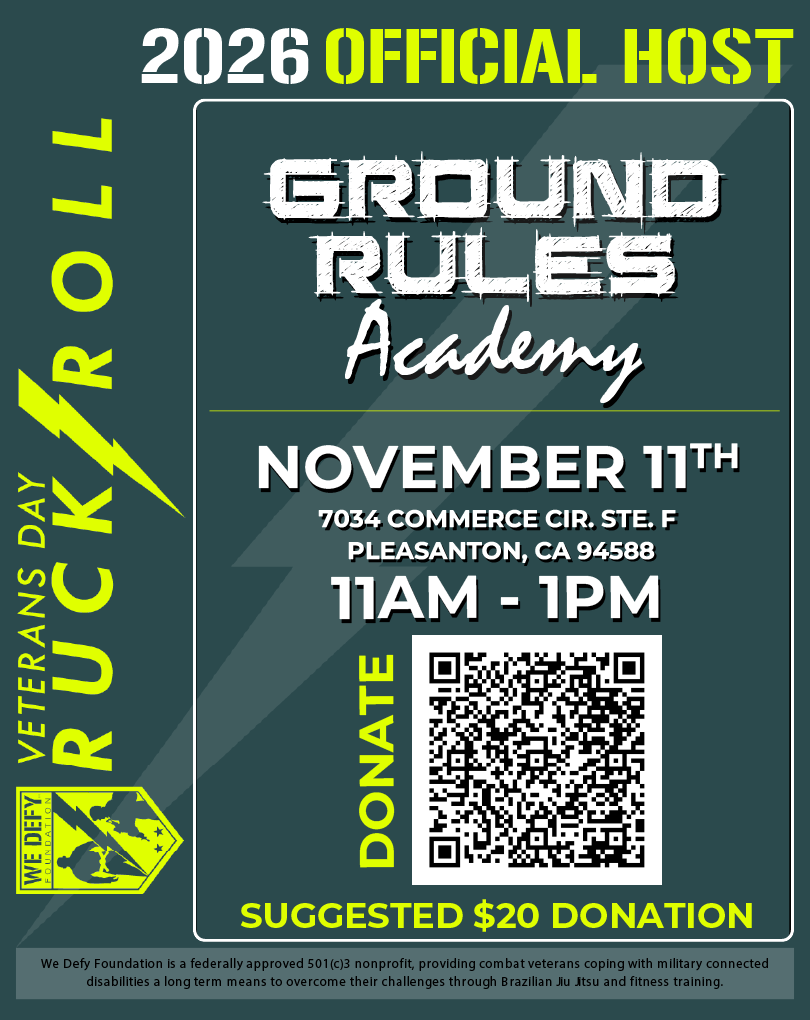
Ground Rules Academy is proud to be the 2026 official host of the Veterans Day Ruck/Roll for the We Defy Foundation! Join us on Wednesday, November 11 from 11am to 1pm for a fundraiser open mat at the academy. We Defy is a 501(c)(3) nonprofit that gives combat veterans coping with military-connected disabilities a long-term way to overcome their challenges through Brazilian jiu jitsu and fitness training.
This open mat is for serious grapplers only (teens and adults). All other classes are canceled on Wednesday 11/11, so the open mat will be the only thing on the mats that day. Donations are optional to attend (the flyer lists a suggested $20 donation), and if you can't make it, donations are always welcome without attending.
All donations go directly to the We Defy Foundation.
Donate to the Ground Rules team
September Technique Review: Stand Up, Pressure Passing, and Turtle Attacks
September was all about the top game. We started on the feet, spent two weeks pressure passing, and then went after the turtle, which is about as classic a jiu jitsu sequence as it gets. Below is a review of the positions and techniques we covered at our Pleasanton academy, why they work, and how they fit together. Whether you're a regular on our mats or just curious about Brazilian jiu jitsu in the Tri-Valley, use this as your study guide.
Week 1: Stand Up (Collar Tie, Russian Tie, High Single, Blast Double, Arm Drag)
Every match starts on the feet, and whoever controls the grips usually controls where the fight goes. We built the week around a simple chain that starts with the collar tie: a hand behind the neck with your elbow tucked inside to frame against their chest, so you can steer their head and feel how they react.
From the collar tie we moved to the Russian tie, a two-on-one where both of your hands control one of their arms and your chest stays tight to their shoulder. That takes an arm out of play and puts you at an angle, which is exactly where the high single leg lives. Grab the near leg high, keep your head up and tight to their body, and lift that leg to your hip so they're hopping on one foot. If they react by posting into you and loading their weight forward, that's your cue to change levels and hit the blast double instead, driving through their hips rather than reaching for their legs.
We also worked the arm drag to the high single. You grab the wrist, pull their arm across their body, and use your other hand on the triceps to drag them past you as you step to the angle. The arm drag and the Russian tie solve the same problem in different ways, since both move you off the centerline so you can attack from the side instead of running into their frame. The mistakes to watch for are shooting from too far away, dropping your head (which invites a guillotine or front headlock), and stopping your feet after first contact.
Weeks 2-3: Pressure Passing (Over-Under, Double Under, Body Lock, Sprawl Pass, Leg Drag, Knee Cuts)
Pressure passing is the old school approach to getting past the guard. You flatten your partner, take away their hips, and make them carry your weight until their guard runs out of options. We covered a lot of passes over two weeks, but they all share the same core ideas: control the hips, keep your head and chest heavy, and never give them the space to square up and re-guard.
Over-under and variations. One arm goes under one of their legs, the other arm goes over the other leg, and your head drives into their hip or thigh. From there you stack their hips up toward their shoulders so they can't turn in, then walk around to side control. The pressure comes from sprawling your hips down and staying tight rather than pushing with your arms, so don't let your hips float.
Double under pass. With both arms under their legs and your grips locked, you stack their hips onto their shoulders, drive your weight forward, and pass to one side. Keep your elbows tight and your posture strong so they can't get a foot on your hip or play off your head.
Body lock pass. Lock your hands around their waist with their legs trapped, drop your chest onto their stomach, and walk your hips over their legs to free your knee. It's a favorite in no-gi jiu jitsu because it doesn't depend on grips on the fabric.
Sprawl pass. When your partner comes up into you, sprawl your hips back and down, flatten them out, and circle to the side. It teaches you to use your weight instead of your arms, and it ties directly back to the sprawl we use on the feet.
Leg drag. Redirect their legs across your body, pin them to the mat with your hip, and get chest-to-chest, or take the back if they turn away. The key detail is keeping their knees pointing away from you so their hips stay stuck.
Cross knee cut and straight knee cut. Both passes use your knee to pin their leg while you control the upper body, but the knee travels a different path. In the cross knee cut, the classic knee slice, your knee slides diagonally across their thigh until it reaches the mat on the far side, while a crossface and a deep underhook keep their shoulders flat. The most important detail in the cross knee cut is getting that underhook. Without it, your partner has access to your back. They can also turn in to face you, win their own underhook, and recover guard; with the underhook, their shoulders stay pinned while your knee does the work. In the straight knee cut, you go straight for the crossface, then drive your knee straight forward along the inside of their thigh, stapling that leg flat to the mat before you walk your hips around to side control. Keep your head low and your weight on their chest as you finish either pass, because the moment you sit back they’ll recover.
Notice how these passes feed each other. If they fight the over-under by turning in, the double under or body lock is waiting, and if they push your head away and extend their legs, the leg drag and knee cuts open up. Good pressure passing isn't about one perfect pass. It's about stacking problems on your partner until they can't solve them all.
Week 4: Turtle Attacks (Top Turtle Control, Clock Choke, Back Takes, Rolling Bow and Arrow, Peruvian Necktie)
Turtle shows up constantly, especially after a stuffed takedown or a guard escape that doesn't quite make it. We started with top turtle control positions, because you can't attack what you can't hold. The goals are to stay heavy on their back, stay slightly to the side rather than directly behind (where they can roll you), and control their hips or near arm so they can't sit through or roll back to guard.
Clock choke (gi). From the side of the turtle, get a deep, thumb-in grip on their far collar across the throat, using your other hand to pull the slack out of the lapel if you need to. Then sprawl your legs back, put your chest heavy on the back of their neck and shoulders, and post your head for base. If they haven't tapped yet, walk your legs around in a wide arc like the hands of a clock. Shallow grips and staying up on your knees are the most common reasons the clock choke fails.
Back control transitions. Turtle is one of the best doors to the back. Secure a seat belt grip (one arm over the shoulder and one under the armpit), keep your chest glued to their back, and insert your hooks or roll them to establish back control. The back is the most dominant position in jiu jitsu and is worth 4 points in IBJJF competition, so these transitions pay off.
Rolling bow and arrow (gi). From the turtle, get the deep collar grip first, then lay your leg across their back, and grab the pants before you roll. The roll brings your partner onto their side, and from there you extend to finish the bow and arrow choke. It’s a great option when they defend the back take by staying compact.
Peruvian necktie. This one comes from the front of the turtle. From a front headlock, trap their head and one arm and lock your hands under the neck with a gable or S-grip. Step one leg up so the back of your thigh sits on the back of their head, then sit back at an angle and throw your other leg across their back. The squeeze comes from extending your body rather than muscling your arms, so keep the grip locked the whole way through, and apply it slowly in training because it loads the neck quickly.
Together these give you a threat from every side of the turtle: the clock choke from the side, back takes and the rolling bow and arrow from behind, and the Peruvian necktie from the front. When your partner defends one, they usually open another.
Putting It Together
Put September together and you have the classic old school BJJ sequence: take them down, pass the guard, and when they turtle to avoid the pin, take the back or choke. We're finishing the month with mount submissions, and October flips the script so you learn to survive and escape those same positions.
October Curriculum
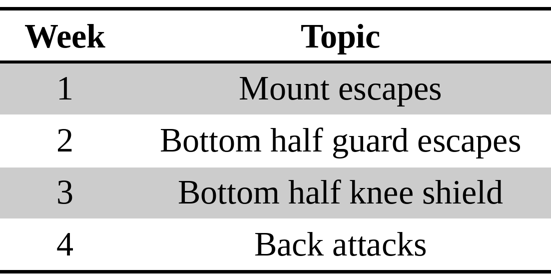
Have you figured out the pattern yet? September was the top game, so October flips to the bottom. We start right where September leaves off, so after a week of attacking from mount, we'll learn to escape it. From there we spend two weeks on bottom half guard, starting with escapes and then building the knee shield, before we finish strong with back attacks!
Want to see what these classes feel like? Ground Rules Academy is at 7034 Commerce Circle, Suite F, in Pleasanton, and you can reach us at info@groundrulesacademy.com or 925-400-8805 to set up your first class.